
Standing in the Shadows
Dezron Douglas Concert Revue

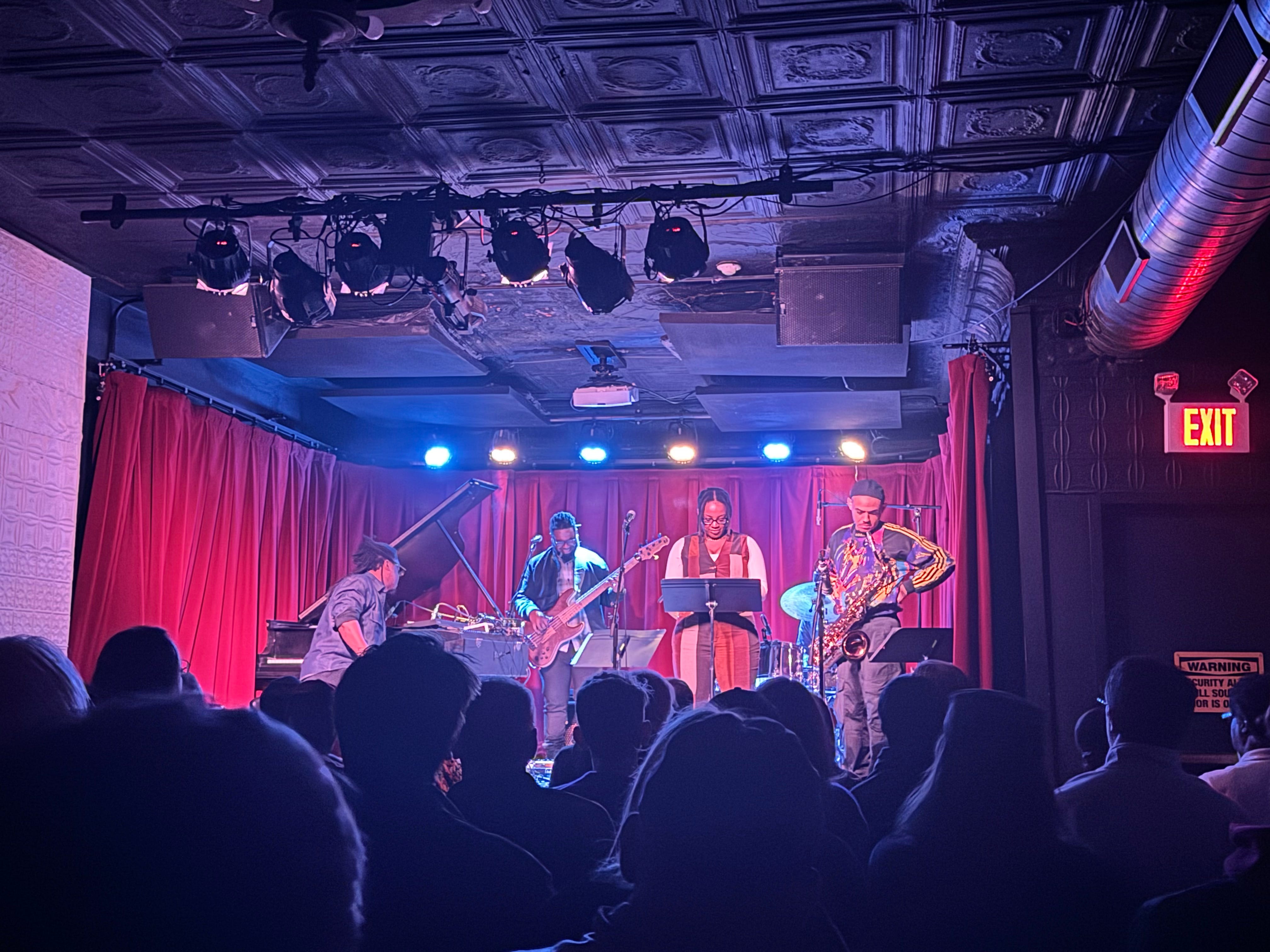
Solar Myth, Philadelphia, December 18, 2025
When you’re standing in the heart of the Avenue of the Arts it feels majestic. Less crowded than New York, with the charm of the lights, the restaurants, the old buildings…it’s why so many wedding and engagement shoots are captured on that narrow strip of median. Those shots blur the background, smooth the rough edges and the energy pulsing through the city, good and bad. The Avenue of the Arts is really Broad Street, the main vein running through the city of Philadelphia.
The north most point runs you into a furniture store in a Korean neighborhood, past Temple, past north Philly, buttressed up against old Jewish and Greek neighborhoods. It cuts off before a hidden enclave, one that used to hold the Underground Railroad routes and now has houses. On the south end, you run straight into the stadiums, through Italian and Polish neighborhoods, the heart of the Mummers, through gentrification that couldn’t quite make up its mind. But like any vein, part of that pulsing line gets buried in the flesh of the shadows.
On a Thursday night, after the sun has set and the snow is lingering, Solar Myth sits ensconced in one of those shadows. City Hall and Billy Penn sit in the distance, their backs turned on this neighborhood in transition. The lights of large venues wink off in the distance, and cars crowd each side of side streets. Rowhomes, brownstones, and rebuilt places stack up on the quiet side streets. Local bars promise soul food and chicken while the bright lights of Target, Whole Foods, and Chase Bank blaze bright, reminding everyone that the takeover is happening. A block away, the sidewalk is silent, uneven, with a check cashing place and a space for dancing girls side by side. The store fronts are old, ominous. Where is Solar Myth?
It’s easy to miss with it’s simple print. Step inside and it’s a converted row house. You can see where the developer ripped the stairs off the wall exposing the arch of brick towards the back. It is a bar, with the same stools you used in high school chemistry labs, and a cozy run of wooden benches along the back wall. The bar hosts vinyl, tabbed out by genre, with potions and promises lining the lower shelves. The covers are ripped off of JbL speakers as they sit, pale and exposed in their cupboards. A rotary mixer and a single turntable dangle at the far right. The room is filled with music.
Diving deeper into the room, there is a hulled out space in the back. Then, a door. Behind it is a small room, 100 outdoor wedding chairs, sorted in rows five each, ten deep, two sides. Strong steel tubes run parallel above, pushing out warm air along designated vents as a black ceiling fan struggles to keep up. The ceiling is intricate, painted black and truncated by construction, it holds an old story of something more. On stage, Dezron Douglas does the same. He is connecting his past and present in a talk given by WRTI, the local jazz station. He tells the story of Hartford Connecticut, of the Black church, and making music in New York. His words are humble but sure, and his spirit exudes a gratitude for the moment, a connection to ghosts of days gone by. Will we find the same in the music?
The stage is set with a Steinway baby grand in black, a Rhodes connects to it and all manner of buttons, knobs, and pedals sit on top. A drum kit is dropped in the far right backdrop. Five people will come to share the stage: Dezron, with his bass guitar and occasional vocals, George Burton on the keys, Joe Dyson on the drums, and Emilio Modeste on the saxophones (tenor and alto). A woman by the name of Silka intermittently centers the stage, providing vocals to the music.
It is a small space, that fills up quickly, with bodies and sound. People amble in bringing their drinks from the bar, swapping stories from jazz shows they’ve seen and experienced. Three photographers mill about elbows tucked and fingers at the ready to snap moments from the sides. A student is recording on a camcorder. They are familiar, knowing but not familial, there is a distance and disdain that lingers, and games of one upmanship occur.
The music begins with the piano. It calls back to when Herbie Hancock started experimenting with sound and synth as were taken through a piece that manipulates time, making it feel elongated as the sounds stretch over us, moving beyond the mere 88 keys. George Burton is playing solo.
Up the center aisle, in funereal procession, the drummer, saxophonist, bassist, and singer arrive, and the set opens in earnest with a lively welcome song. The vocals are underwhelming and the quality of the microphones and mixing do them no favors. George Burton scats and grunts and sings while he plays, losing himself (and his glasses) in the moments. It is as if he is inhabited at times by spirits that overcome him. Dezron locks in the groove comfortably as the drummer goes along, in tune enough to follow the minor tempo changes.
They introduce a song called Janice, composed by Emilio Modeste. It is a song that speaks to love, loss, and longing all without words. It’s the kind of song where the saxophone sings so sweetly that you want to ask the questions that will never concern you.
The strength of the group is that they each understand how to fit in space and time while relating to each other. The drummer is confident in his cadence, knowing when to pull back and how to solo without losing rhythm. The bass is played in a way that sets the groove, but doesn’t shy away from sharing its own story. The keys then slide in, weaving through the vocals and the sax, slipping in notes and sounds that smooth rough edges, and wrap around the foundation of the songs. It is a weaving, where the alto and tenor sax bring rough hewn emotions together, to be sown and sanded by the vocals. There is consciousness and intention.
Each time the single door in the back opens, the lively sounds of the bar spill in, breaking the spell and reminding you that this small setting is a different world. It is something set aside in the shadows, born of effort and appreciation. The other patrons are moved by the music, yelling out their enthusiasm, leaning in, clapping loudly and climbing to their feet. Iris and the Rainbow is played with a cadence that echoes Gil Scott Heron’s The Bottle. Recognition of the rhythm moves the crowd, these are music lovers.
The set closes out with Little Birdie, a Charlie Brown favorite that’s given a funky groove that fits. And then, with much fanfare, it’s over. The sounds of vinyl and laughter take over, and souls slip out into the silent night of shadows, wondering whether it was all a dream.
This makes me want to go see a live band now!!